Showing posts with label Portraits. Show all posts

Saturday, May 21, 2011

Drawing Rapture......

In defiance of the upcoming Rapture, I have decided to revive my teaching blog.  I will be teaching Drawing I this summer term, and will use the blog in my classroom and to exhibit student work.  Please consider following along, if you are so inclined.....

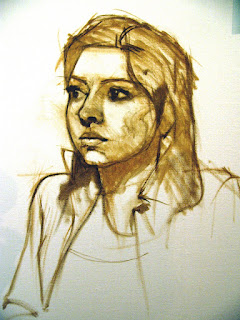
In the meantime, here is a student painting by Kay Thomas (from last semester):

Thursday, May 1, 2008

Favorite quote from the Jon Houghton workshop


Jon Houghton, Nicole, watercolor demo

Jon did this demo...sorry, this was the best slide I got of it and he took the portrait with him. Anyway, he carefully drew her features and then mixed up a flesh tone and THREW it on the paper! We all gasped. He laughed and said something about "it can't get any worse now". Then he proceeded to create this lovely work. But, it was a valuable lesson even for me----you cannot be afraid to make mistakes. A certain and deliberate boldness is liberating. I also noticed an economy of marks---I know my students have heard this before....if you can say it with one stroke---why use twenty?

This is an oil sketch demo Jon did of Nicole as well. Lovely. I will post his portrait of Tamra (aka Michelle :-) as soon as I get a good slide of it.

But my favorite quote: "The mind cannot comprehend what the rear cannot endure".


Thursday, April 17, 2008

Jon Houghton Portrait Workshop at CPCC


Jon Houghton is a portrait artist who lives and works in Florida and has given an annual (or semi-annual) portrait workshop with Elizabeth Ross for years. We have reached capacity on this year's workshop already!
Here is the schedule: Please note: I have corrected the dates.
Thursday night (April 24): Demo in oil, Overcash 159, Central Campus 6pm (ish).
Friday morning (April 25) Demo in watercolor, Overcash 159, 9:30am; afternoon...work, work, work. Remember, Elizabeth Ross reception at 5pm!
Sat. morning (April 26) work, work, work.....10am till 4pm(ish)
Here is Jon's supply list:
All: vine charcoal (soft or medium), newsprint pad (16x20 or larger)
Kneaded eraser, chamois cloth, small pencil sharpener.

If using Oils:
Palette, Turpenoid, canvases or panels (16 x 20 to 20 x 24), a medium,
rags or paper towels,
Paints: ivory black, raw sienna, yellow ochre, cadmium yellow medium, cadmium red light, alizarin crimson, burnt sienna, raw umber, burnt umber, white (any kind), sap green. This list is just the colors used in flesh tones. Bring what ever other colors you
like as well.
Brushes: I use all kinds and sizes, but they are all in good condition. Don't bring a
bunch of old dried "sticks" with clotted bristles. I'd say the minimum set would be
4 filbert bristles in sizes 2, 4, 6, 8, and a small detail brushes like a
"Monarch" no. 2, and 4, another detail brush is the W&N university series synthetic.

Pastels:
As many as you can bring. I use a set of Nu-pastels and a complete 330 stick set
of the old Grumbacher pastels, I also have a number of Rembrandts, schminckes, and
others. You simply can't do much without a variety of colors.

Watercolors:
Most watercolorists will have the paints they need. If you want to be sure, check the list of oil colors and add cerulean blue. No white necessary of course. Brushes should be good quality sables including at least one size 8 brush, (Raphael, W&N series 7, or something equivalent. For paper, I use d'Arches 140 pound cold press or something equivalent like Fabriano. For workshops I usually divide the paper into halfs or quarters ( 15 x 11). Their are many good plastic palettes available. It should have plenty of room to mix and sections for pure color.
And here are some more examples of Jon's work:


Wednesday, March 12, 2008

Mint Museum Portrait class Day 3 Student Work

Students, most of whom have little or no experience in portraits, got three colors---burnt sienna, ultramarine blue and white to create their underpainting....in less than 2 hours! Great start...we will finish these up in our last class this week.


Portrait Painting at the Mint: Day Three

Today’s class will offer a slightly different approach and another traditional technique. We will focus on value today, and color during class 4. Do not worry about warm and cool today---only value. You will only use three colors for today’s exercise: burnt sienna, ultramarine blue and white. You will be surprised by how much you can do with just these three colors.

Step One: I begin with a transparent monochrome as in Day One. Keep the paint thin and washy.

Step Two: I add ultramarine blue to my burnt sienna to create a darker value. Then I paint in the shadow on my model. I add a value to my negative space (background). My paint has a little more body than in Step One, but not heavy.


Step Three: I add a touch of white to some burnt sienna, and paint in the mid tones. I use a dry brush to blend tones a little; but try to not over blend at this point. I’ll actually be covering a lot of this up in later steps. However, since I will be glazing color over this, I don’t want my surface to have a lot of ridges. It will catch the glazes and make streaks on my painting.


Step Four: I mix a lighter value using burnt sienna and white and paint in areas of light. I redraw as needed at any step along the way. For example, one ear was considerably higher than the other….Again, I may use a dry brush to blend a little if desired. Occasionally I like to pretend I’m Leonardo da Vinci and smear a little with my thumb or fingers, but somehow it never measures up….I just keep trying.


Step Five: I mix an even lighter version of burnt sienna and white and painting in highlights. I also refine tones in between.
Remember to look for the six categories of light as listed in your Day One handout:
1. Highlight: (nose, brow bone, cheek on my model)
2. Light: (turn of the cheek, forehead)
3. Shadow: (side of the nose, side of the face)
4. Core of Shadow: (right side of cheek, nose, under eyebrows)
5. Reflected Light: (right edge of jaw, neck)
6. Cast Shadow: (under nose, neck)


Helpful Hints: Always work from general tones to more specific ones. For example, don’t get caught up in details like the eyelids until you’ve created a general pattern of light and dark. I always start with the three basics: shadow, midtone (or halftone) and light, then refine from there.

Next week we will focus on adding color and color temperature to the underpainting created today

Friday, February 29, 2008

Portrait Painting at the Mint: Day Two


We are working with a limited palette: Titanium white, cad yellow med., cad red med. Ultramarine blue, burnt sienna, raw sienna (or yellow ochre) and burnt umber
Step by step example:

Step One: Transparent monochrome
Using burnt sienna (it’s warm and transparent), sketch in the structure of the face and indicate light direction. Don’t worry about details; work from the general at this stage. Your paint should be fairly thin…use a rag to wipe back into it.


Step Two: Lay in shadows. Combine a little burnt umber to your burnt sienna. Paint should be thin, but not watery. Check proportions, redraw if needed. Be sure to also address negative space…remember, you will be creating edges via value and color shifts rather than line…Reminder: shadows are warm

Step Three: Halftone Halftone is cool….I used raw sienna (or yellow ochre), a touch of cad red (or you could use alizarin crimson), a bit of white….then I added just a touch of ultramarine blue to cool it down. What you don’t want to have is green---you’re looking for a neutral that’s a bit cool.
I’m still not too worried about details

Step Four and Five: Light and some details. Light is warm. I mixed a flesh tone that was a bit on the peachy side…same combination as above, but I omitted the blue and added a bit of cad yellow.
Compared to the Rubens portrait on page one, my model’s skin tone is darker and more olive.

At this point, I allow myself to take out a smaller brush, and develop some of the details, such as the eyes. I still keep it loose.

The Final Stage: Highlights and refining. Once I’ve laid in all the basic information (as in steps 1-5), then I mix a very light, slightly cool flesh tone. Remember, white is cool, so if you add quite a bit of white to your paint, it will be cool. But, use highlights sparingly or it will turn your painting "chalky".
I also refine any other areas that need it…if the paint isn’t quite thick enough, or if I need to move a shadow slightly.
I also darken the negative space. I could certainly refine more, but this is all the time I allowed for this sketch.....

Some helpful hints: Don’t try to blend too much. Strokes of varying value and color are far more interesting than continuous tone in a portrait like this. Flesh tone is not a single color you mix up and apply to your canvas…it’s an effect you create by laying related colors side by side. .

Thursday, February 21, 2008

Portrait Painting at the Mint: Day One

For the next four Thursdays I'll be conducting a portrait painting workshop at the Mint Museum. Here's a synopsis on what we will do on Day One.

Hints on lighting the model: Position a single light in front of the model, slightly to one side and slightly above the model. This is the best position to display the planes of the face, and enhance the three-dimensionality of the form. Multiple lights and full frontal lights will flatten the form, and lighting from below will create some exaggerated shadows. Look for the little triangle on the cheek opposite the light….
Review proportions:


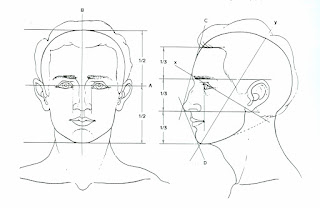
Guidelines for the placement of features:
Note in Fig. A that the face is divided into halves from the top of the skull to the bottom of the chin.
The eyes are the midpoint.
Note in Fig. B that the features are divided into thirds; the hairline to the brow bone is one third. The brow bone to the base of the nose is another third. The base of the nose to the bottom of the chin is another third.
Further, the section from the bottom of the nose to the chin can be subdivided into thirds, with the lips located about one third of the way down.

Note the location of the ears within the middle third of the features. Also, note the slope of the face in profile view; this may change greatly depending on the individual; there is no substitute for really looking at your model---remember, these are just guidelines.

Find key reference points and mark them lightly on your canvas/paper. You can use charcoal, conte, or a brush. Pay attention to placement on the picture plane
Begin a transparent monochrome with thinned burnt sienna. Have a rag handy to wipe back into the image. This is when you make major decisions about drawing. Don’t skimp on this. Note the image above (by Chris Saper: visit http://www.chrissaper.com/ )

Now let’s look at the six categories of light on this Rubens painting and note whether they are warm or cool:
1. Highlight is cool. The lightest value, cool color paint on an object.
2. Light is warm. The next lightest value, warm color paint - and it continues to get lighter still as it approaches the area of highlight.
3. Halftone (where light and shadow meet) is cool. A mid-value, cooler color paint where light begins to turn into shadow - but can't be defined as either light or shadow.
4. Shadow is warm. A dark value, warm color paint.
5. Deep Shadow (cast shadow at the origin) is hot. Darkest value, hottest color paint.
6. Reflected light within a shadow is as close to pure color as you can make it. The reflected light should match the value of the shadow and it can be either warm or cool in color.
reference: http://forum.portraitartist.com/showthread.php?t=281


Begin by mixing a warm neutral for shadow, and paint the corresponding areas on your monochrome. Your paint should be thinned a little, but not transparent. As you apply the paint, think like a sculptor---as if you are building the planes of the face. Place your strokes in the direction of the plane. I will demo mixing the colors....
Next, mix a slightly cool neutral that is lighter than your shadow. Apply this to your halftone areas.

This should take us through the first day.....see you next Thursday!

Thursday, January 24, 2008

What if.........

What if I told you to create a drawing using a single contour line? No, you can't shade, you can't overlap....just a single contour line to describe the form you're drawing. What would you do?

Would it look something like this?


The contour line begins at the tip of his nose and spirals around...
Thanks to Carolyn Greer for sending me this.....

Wednesday, October 31, 2007

Free Portrait class at CPCC

Free college day is Nov. 3, and I'll be leading a 1 hour portrait class. Here's a link to the info:

http://www1.cpcc.edu/free-college-day

Everything is provided! Enjoy---but you must pre-registered---only a few spots left!

Wednesday, October 3, 2007

Enter Visual Arts Raffle at CPCC

Visit the CPCC Ross Gallery or Pease Gallery Thursday, Oct. 4 through Oct. 23 to enter two different raffles to win original artwork by CPCC faculty and artists Elizabeth Ross and Carolyn Whitman. The cost is $1.00 per ticket. The raffle will conclude at the end of Fall Fest on CPCC Central Campus on Oct. 24, 2007. Tickets will be sold at the Visual Arts Tent all day. Proceeds will go toward a museum trip for Visual Arts students.

Raffle #1:

Win your choice of the following framed giclee prints by Elizabeth Ross:


Smoke Tree Wings by Elizabeth Ross


Maze by Elizabeth Ross


Both prints are valued at $650


Raffle #2
Win a portrait sketch by Carolyn Whitman, done from life or your photos.

Here's a sample of one of my sketches:


Dot by Carolyn Whitman
The value of a pastel portrait like this is about $300. You can see more examples of my portrait work by visiting http://carolynwhitman.com/Artwork/portraits.html
Please contact me if you have questions.

Wednesday, September 12, 2007

Portrait Workshop at the Mint Museum, Part II

Drawing Portraits---Chiaroscuro----- Mint Museum Sept. 13, 2007
Image Reference: The Artist’s Complete Guide to Drawing the Head, William L. Maugham, is used for educational purposes only.
Using value to find the form…
Chiaroscuro refers to the gradual shift from light to dark as is falls across a curved surface. It is a great way to build solid, believable forms. Keep in mind, you need an identifiable light source; one in the front, slightly above and to one side is best. If the light is too harsh, soften it by placing a white sheet of paper between the model and the light---or bounce the light off the white paper or board.

We will use grey Canson paper, black conté and white conté for this exercise.

First, as few words about value: Value is the relative lightness or darkness of an object or space

Value is relative to three things:
1. local value (the value of something in even lighting conditions)
2. value of surrounding area
3. amount of illumination

When creating a drawing using chiaroscuro, we look for six categories of light:

Because we are using grey paper, one of the categories will be the local value of the paper.
We will shade with the black for shades darker than the paper, and heighten (lighten with white) for the areas lighter than the paper.


Left: Begin by lightly sketching a gesture drawing of the general dimensions of the head, including the shoulders. Check you proportions now. You are using only your black conte.
Center: Find the major bones/structure of the face and lightly suggest shadows. No harsh lines or edges here….you’re still looking, measuring, checking proportions. Still using only black conte.
Right: Keep defining shadows, looking at structure. Start to build up darks. If you are using a stick of conte, snap it into a small section and use the side to build the planes of the face. Remember, you are only shading the areas darker than the gray of your paper.


Once the structure is “set” and you are satisfied with the likeness, push the values and work on edge quality. Soften edges that you want to fade out, and emphasize edges that are hard planes (though you won’t find many of those). If you can’t see details, don’t include them. Draw what you see.

The last step is to add the highlights. It doesn’t take much in terms of highlights to enhance the roundness of the form. A common mistake is to add too many whites, and flatten the face, so use them sparingly.
Reference: The Artist’s Complete Guide to Drawing the Head, William L. Maugham

Portrait Workshop at the Mint Museum

Here is a synopsis of the subjects covered in the Mint Museum Portrait workshop from Sept. 6 and Sept. 13, 2007

Please note: Images References: Drawing the Human Head, Burne Hogarth; Drawing from Life, Brown and McClean; The Artist’s Complete Guide to Drawing the Head, William L. Maughan. These images are used for educational purposes only.

Beginning exercises:
Hints on lighting the model: Position a single light in front of the model, slightly to one side and slightly above the model. This is the best position to display the planes of the face, and enhance the three-dimensionality of the form. Multiple lights and full frontal lights will flatten the form, and lighting from below will create some exaggerated shadows.


The egg shape is simple, but an effective place to start with a full frontal drawing.

By dividing the head with a vertical axis and a horizontal axis at the mid-point each direction, you find the approximate location of the center of the face and the eyes.

Note the location of all the features from this simple division. More on this a little later.


Left: As the head rotates to one side, the curve central axis becomes visible.
Center: Notice how the features rotate as the axis rotates.
Right: As the head continues to rotate, the cranium becomes more visible.

In these illustrations, notice how the features are aligned;

The center of the eye aligns vertically with the corner of the mouth.
The ear sits between the brow bone and the end of the nose.
The inside corner of the eye aligns with the edge of the nostril

It’s also very important to think of the face as a series of planes that combine to create a three-dimensional form. It’s always best to work from life, but we all must use photos at times---this is when we really have to conceive of the head as a three dimensional form.


As the head shifts up and down, the curve of the horizontal axis is more visible, following the shape of the brow bone. Note how the chin mimics the curve of the brow bone.
Again, note the alignment of the eyes to the lips and nostril.


Guidelines for the placement of features:
Note in Fig. A (left) that the face is divided into halves from the top of the skull to the bottom of the chin. The eyes are the midpoint. Note in Fig. B (right) that the features are divided into thirds; the hairline to the brow bone is one third. The brow bone to the base of the nose is another third. The base of the nose to the bottom of the chin is another third.
Further, the section from the bottom of the nose to the chin can be subdivided into thirds, with the lips located about one third of the way down.
Note the location of the ears within the middle third of the features. Also, note the slope of the face in profile view; this may change greatly depending on the individual; there is no substitute for really looking at your model---remember, these are just guidelines.


Diagram of heads in perspective
I recommend you do a lot of these quick drawings so that the proportions of the head and the axis of the head become second nature to you. Do them quickly---only a few minutes at most. I like to do them in airports, resturants, the park, at lectures, etc.

Helpful hints: As with any drawing endeavor, work from the general to the specific. It’s a good idea to start with some gesture drawings to warm up, and once you’re ready to begin, start with the broad shapes and really looking at the subject. Guidelines are helpful, but attaining a likeness is about really looking, measuring and looking again. At some point, you leave the guide behind and trust your eye…

Remember the negative space in your drawing; it’s important to place the form in a space to enhance the three-dimensionality of the subject.
References: Drawing the Human Head, Burne Hogarth; Drawing from Life, Brown and McClean; The Artist’s Complete Guide to Drawing the Head, William L. Maughan